Part 2 of Why Most New Year’s Resolutions Quietly Fade
What Actually Helps Change Last
If Part 1 felt uncomfortably familiar, that’s not a bad sign. It means you’re seeing clearly.
Awareness isn’t failure. It’s the moment the fog starts to lift.
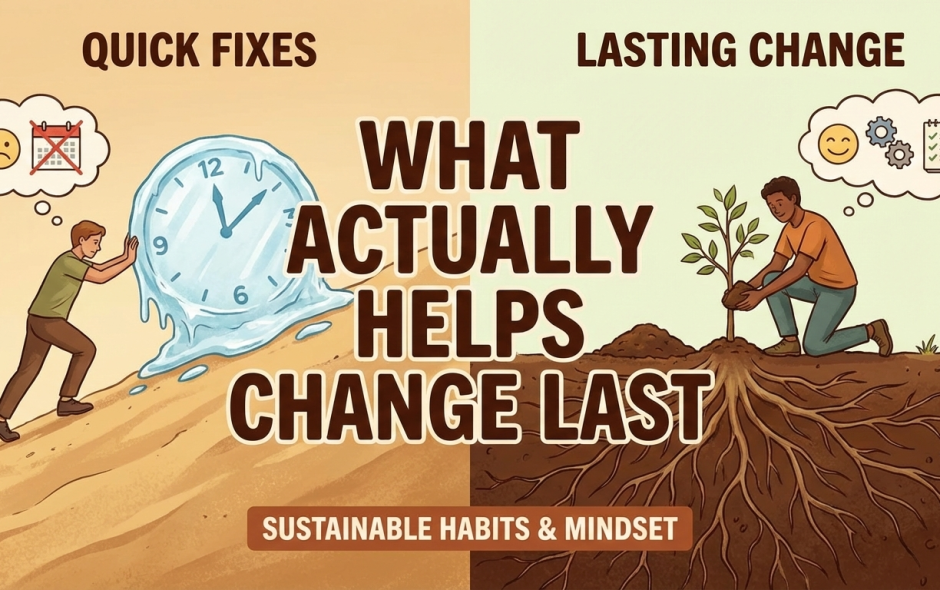
Most of us don’t need stronger willpower or better intentions. We need a better understanding of what change actually asks of us. When you look closely, lasting change isn’t about intensity. It’s about alignment. When the right conditions come together, effort stops feeling like a fight.
Here’s what that looks like in real life.
Start With Readiness, Not Resolve
We’ve been taught to start with a bold decision. Make the commitment. Draw the line. Announce the change.
But readiness isn’t the same as resolve.
Readiness has less to do with courage and more to do with capacity. Do you have enough energy to begin? Enough space to think? Enough margin to absorb disruption without collapsing?
A strong decision made in a depleted season often turns into self-blame later. Not because the decision was wrong, but because the conditions couldn’t support it yet.
Change lasts longer when it starts where capacity exists, even if that starting point feels small or unremarkable. Quiet beginnings often go further than dramatic ones.
You don’t need a louder commitment. You need a starting point that doesn’t exhaust you.
Let Identity Lead, Not Chase
Many people try to change by acting like someone they don’t yet believe they are. They perform discipline. They imitate consistency. They push behavior ahead of belief.
That works briefly. Then it gets heavy.
Identity doesn’t change because you announce it. It changes because you experience yourself differently over time. Each small, believable action becomes evidence. And evidence slowly reshapes self-understanding.
When actions feel honest, consistency stabilizes. When actions feel fake, effort drains quickly.
Change becomes easier when behavior stops trying to prove identity and starts expressing it. You don’t become disciplined by forcing discipline. You become disciplined by repeatedly doing small things that teach your brain, “This is who I’m becoming.”
Identity grows from lived experience, not pressure.
Replace Motivation With Rhythm
Motivation is a spark. It’s not a structure.
At the beginning of the year, motivation feels generous. It makes big plans seem reasonable. But motivation was never designed to be reliable. It comes and goes with sleep, stress, mood, and circumstance.
Rhythm is what carries you when motivation goes quiet.
Simple routines remove the need to decide every day. They reduce friction. They make progress feel lighter. Rhythm doesn’t ask how you feel before it shows up. It just shows up.
When change depends on feeling motivated, it collapses on tired days. When change is supported by rhythm, it survives them.
Structure isn’t restrictive. It’s supportive. It’s how you stop negotiating with yourself every morning.
Anchor Hope Instead of Overworking It
Hope matters. Without it, change wouldn’t even begin.
Hope helps us imagine something better. It gives words to desire. It reminds us that growth is still possible.
But hope has limits.
Hope points forward. It doesn’t build the road. It doesn’t manage pacing. It doesn’t carry consistency through boring or difficult seasons.
When hope is asked to do everything, it becomes fragile. Enthusiasm fades. Disappointment grows. And people start questioning themselves instead of the structure.
Hope works best when it’s anchored. When it’s paired with rhythm, process, and patience, it becomes steady instead of exhausting.
Hope is a compass, not an engine. It tells you where you’re going, not how to get there or how fast.
Design for Imperfect Progress
Real change includes interruptions.
There will be missed days. There will be weeks where things don’t go as planned. There will be moments when momentum stalls.
Plans that assume perfection don’t survive real life.
Consistency isn’t about never slipping. It’s about returning. Growth stabilizes when returning becomes normal instead of shameful.
Self-compassion doesn’t lower standards. It protects momentum. When people feel safe to continue after a mistake, they do.
Progress lives in the middle space, where effort continues even when execution isn’t perfect.
Let the Environment Do Some of the Work
Willpower is not as strong as context.
What’s visible gets repeated. What’s easy gets chosen. What’s reinforced quietly shapes behavior long before intention enters the picture.
When the environment keeps cueing old habits, effort drains quickly. Not because discipline is weak, but because friction is constant.
Small environmental changes reduce the need for constant self-control. They make the right choice easier and the old choice less automatic.
Change sticks faster when the setup stops fighting you.
Name the Emotional Why
Many goals are carrying more than practical intent. They’re carrying emotion.
A desire for discipline may be about control. A desire for success may be about worth. A desire for change may be about safety or belonging.
When behavior is asked to heal an unnamed emotional need, it eventually buckles under the weight.
Naming the emotion doesn’t weaken the goal. It strengthens it. Clarity reduces pressure. Honesty allows habits to support healing instead of trying to replace it.
Behavior works best when it’s aligned with truth, not covering it.
Respect the Speed of the Brain
Change feels slow because it’s being built.
Old habits are strong because they’ve been practiced for years. New ones feel awkward because they’re new. That discomfort isn’t failure. It’s formation.
The brain rewires through repetition, not intensity. Progress often feels invisible before it feels stable.
When slowness is mistaken for weakness, people quit too early. When biology is respected, patience becomes a strategy.
Nothing is wrong with you because this takes time.
Let Change Be Shared
Change gets heavier when it’s carried alone.
Support doesn’t remove effort, but it steadies it. Encouragement quiets self-doubt. Perspective interrupts discouragement. Accountability makes returning easier.
We weren’t designed to grow in isolation. Not because we’re incapable, but because connection strengthens persistence.
When someone else knows what you’re trying to build, the work feels less lonely.
Alignment Over Intensity
When you step back, the pattern becomes clear.
Lasting change doesn’t come from pushing harder. It comes from arranging life so growth has room to breathe.
Timing matters.
Identity matters.
Rhythm matters.
Hope matters.
Environment matters.
Emotion matters.
Biology matters.
Support matters.
When these begin to work together, change stops feeling like pressure and starts feeling like formation.
Not dramatic.
Not punishing.
Just steady, honest progress.
That’s how change lasts.
Discover more from In Christ Living
Subscribe to get the latest posts sent to your email.