A balanced, Scripture-grounded look at one of the most painful questions believers face.
Before we open a single verse, let us sit with the questions. Because they are real. They are being asked right now in living rooms and late-night prayers by genuine believers who are hurting and confused.
These questions carry weight because they sit at the intersection of two things we hold deeply: our love for family and our desire to obey God. And when those two things seem to pull in opposite directions, we feel torn, guilty, and confused.
This article will not give you a quick answer. It will give you something better — the full counsel of Scripture. Because the Bible speaks to both sides of this tension, and any honest treatment of the topic must hold both sides with equal respect.
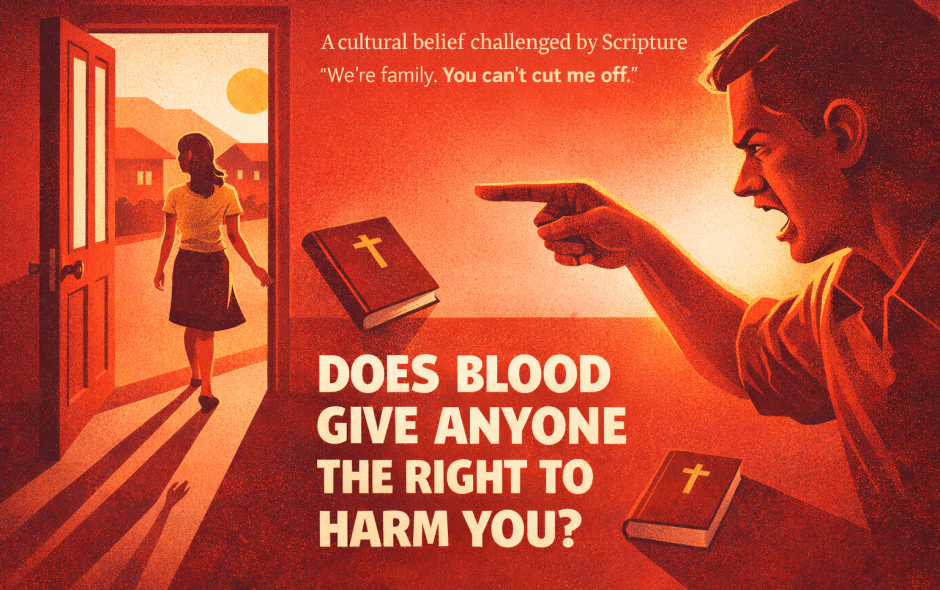
Does Blood Give Anyone the Right to Harm You?
Many people — whether consciously or not — use biological connection as a moral licence. “I’m your mother, so you must accept how I treat you.” “We’re family, so you can’t cut me off.” This logic is deeply embedded in culture. But it is not embedded in Scripture.
Nowhere in the Bible does God grant a person the right to mistreat another simply because of a shared bloodline. In fact, the Word is strikingly clear that we are to be wise about who we allow close access to our lives — regardless of who they are.
“Above all else, guard your heart, for everything you do flows from it.”
— Proverbs 4:23 (NIV)
Notice the phrase “above all else.” This is not a casual suggestion. It is a divine priority. God places the guarding of your heart — your inner life, your peace, your spiritual and emotional wellbeing — above virtually everything else. Why? Because everything flows from it. Your decisions. Your faith. Your relationships. Your fruitfulness. A contaminated heart produces a contaminated life.
“Do not make friends with a hot-tempered person, do not associate with one easily angered, or you may learn their ways and get yourself ensnared.”
— Proverbs 22:24–25 (NIV)
This warning is given about general associations — and family members are not exempt. God here does not say, “unless they are your relative.” The principle stands: a person who is consistently destructive in temperament is someone you are to limit your association with. Not out of hatred — but out of wisdom. Prolonged exposure shapes us in ways we do not always notice.
“Do not be misled: Bad company corrupts good character.”
— 1 Corinthians 15:33 (NIV)
Paul wrote this as a broad principle of life. Destructive company — whether a stranger or a sibling — has the power to erode who you are. Your faith, your peace, your character, your identity in Christ can all be worn down by someone who is consistently toxic, even if they are your own flesh and blood.
What Does True Love Actually Require?
Here is where many believers get tangled. We read 1 Corinthians 13 — “love bears all things, endures all things” — and we conclude that love means unlimited access, unlimited tolerance, and unlimited suffering at the hands of those who harm us. But this is a misreading of what biblical love actually demands.
Love bears all things — but bearing something is not the same as being crushed by it. A bridge bears weight; it is designed to. But even a bridge has a load limit, and exceeding it destroys the bridge and everything on it. Love is not a command to be destroyed.
Forgiveness is not the same as restored accessYou can release someone before God — letting go of bitterness and entrusting the matter to Him — without restoring them to a position where they can harm you again. These are two entirely separate acts.
Love can exist at a distanceYou can genuinely love someone, pray for them, wish them well, and hold no ill will in your heart — while also recognising that closeness with them consistently damages you. Distance is not hatred.
Protecting yourself can be an act of loveGuarding your health, your peace, and your capacity to function does not only benefit you. It protects your children, your spouse, your ministry, and everyone else who depends on you being whole.
Enabling harm is not godly loveContinuing to allow destructive behaviour without consequence is not grace — it is enablement. Real love, at times, says: “I love you, but I will not participate in what is harming both of us.”
But What About Honour, Forgiveness, and Reconciliation?
This is where the full balance of Scripture must be heard. Because the Bible does not only call us to guard ourselves. It also calls us to love sacrificially, pursue peace, forgive generously, and honour our parents. These are not suggestions. They are commands. And they must be held with equal weight.
“Honor your father and your mother, so that you may live long in the land the Lord your God is giving you.”
— Exodus 20:12 (NIV)
Honouring parents is one of the Ten Commandments — it carries real spiritual weight. But honour does not mean obedience without limit. A grown adult can honour a parent by treating them with dignity, holding no bitterness, wishing them well — even when wisdom requires physical or emotional distance. Honour is an attitude of the heart. It is not a requirement to accept mistreatment indefinitely.
“If it is possible, as far as it depends on you, live at peace with everyone.”
— Romans 12:18 (NIV)
This is perhaps the most important verse on this topic — and notice what it contains: two qualifiers. “If it is possible.” “As far as it depends on you.” God himself, through Paul, acknowledged that full peace with every person will not always be achievable. He does not demand the impossible. He asks you to pursue peace as much as you are able — and to trust Him with the rest.
“Bear with each other and forgive one another if any of you has a grievance against someone. Forgive as the Lord forgave you.”
— Colossians 3:13 (NIV)
The call to forgiveness is clear and non-negotiable. Bitterness is poison — it harms you far more than it harms the person who wronged you. Forgiveness is not a gift to them; it is freedom for you. But once again, forgiveness is an act of the heart before God. It is not the same as reconciliation, which requires both parties to be willing and the relationship to be safe.
Holding Both Truths Together
The Bible does not present a contradiction here. It presents a tension — and mature faith learns to live in that tension rather than collapsing it by choosing only one side.
You are called to guard your heart AND pursue peace. To forgive generously AND walk in wisdom. To honour your family AND protect what God placed inside you. To love people from the depths of your being AND be discerning about what level of access they have to your life.
These are not opposites. A person can be forgiven and still not be given a key to your house. A parent can be honoured and still be kept at a safe distance. A sibling can be loved and prayed for daily without being granted unlimited access to your emotional reserves.
The question is never whether to love. The question is what wisdom, boundaries, and stewardship look like in this specific relationship — before God, in prayer, with counsel.
Is Protecting Your Peace Faithful Stewardship — or Selfishness?
This is the question that lingers longest. Am I just being selfish? Is this just my flesh looking for an excuse to avoid hard relationships? These are honest questions worth sitting with.
There is a difference between avoiding a relationship because it is uncomfortable and limiting a relationship because it is genuinely damaging. Growth requires discomfort. Sanctification is not always pleasant. We should not run from every difficult family dynamic simply because it stretches us.
But there is a category of relationship that goes beyond discomfort — one that is consistently destructive, draining, manipulative, or abusive. And in those cases, protecting your peace is not selfishness. It is faithful stewardship of what God entrusted to you.
Consider this: the same breath God breathed into Adam, He breathed into you. Your inner life — your peace, your spirit, your emotional health — is something He placed there and called good. To allow that to be continually trampled is not humility. It is poor stewardship of a sacred trust.
Practical Wisdom for the Believer
So what does this look like in practice? Here is what the full weight of Scripture seems to suggest for a believer navigating a harmful family relationship:
Start with prayer, not a decisionBefore anything else, bring the relationship before God. Ask for clarity, wisdom, and a heart free from bitterness. Decisions made in pain alone are rarely wise decisions.
Seek wise counselProverbs 15:22 says plans fail without counsel. Speak to a trusted pastor, elder, or counsellor who can offer perspective from outside your pain.
Forgive first — independently of the outcomeRelease the person before God. Not because they deserve it, but because bitterness in your heart will corrupt everything else. Forgiveness is your act — not a negotiation with them.
Define what is actually neededFull removal of someone from your life is one option. But often, what is needed is a change of access, a change of frequency, or a clear communication of limits — not a complete cutting off.
Hold the door open in your heartRomans 12:18 calls us to pursue peace where possible. Even if distance is necessary now, keep your heart open to the possibility of healing if genuine change occurs. Do not close permanently what God may one day restore.
Do not act in anger or revengeRomans 12:19 says, “Do not take revenge.” Any decision to limit a relationship must come from a place of wisdom and self-care — not from a desire to punish or wound.
“The Lord is my shepherd; I shall not want. He makes me lie down in green pastures. He leads me beside still waters. He restores my soul.”
— Psalm 23:1–3
God’s desire for you is restoration, wholeness, and still waters — not a life of perpetual depletion at the hands of those who refuse to treat you with dignity.
You are not a lesser believer for protecting your peace.
You are not unloving for creating wise distance from harm.
You are not disobeying God by refusing to be destroyed.
He called you to be whole.
Discover more from In Christ Living
Subscribe to get the latest posts sent to your email.